


OMIM ID:
Cataracts, Congenital Sutural with Punctate and Cerulean Opacities
Alternate Names
Defective Genes
Clinical Characteristics
Ocular Features
The anterior and posterior Y sutures have prominent, dense white opacities. The embryonal and fetal nuclei are clear but the cortex contains gray-bluish, sharply defined and elongated as well as punctate opacities. These are denser near the posterior pole and the posterior Y suture is also more heavily involved. The cortical opacities may be arranged in concentric lamellae. Considerable variation in density of opacities has been noted among patients.
Systemic Features
None reported.
Genetics
Inheritance
A large Indian family consisting of 5 generations containing 33 affected individuals has been described. This is an autosomal dominant disorder in which a mutation has been found in exon 6 of the CRYBB2 gene (22q11.2-q12/22q11.23). This region contains four crystallin genes as well as the CRYBP1 pseudogene. It has been suggested that gene conversion between exon 6 of the CRYBB2 gene and CRYBR1 may be responsible for the phenotype. Three additional families with identical mutations in the same CRYBB2 exon have been reported and, since each family seems to have a unique phenotype, it is likely that more than a simple bp mutation is responsible for the cataracts.
Some Coppock-like cataracts (604307) also result from mutations in CRYBB2 at the same location but others have mutations in the CRYGC gene. Type 2 congenital cerulean cataracts (601547) have also been associated with mutations in the CRYBB2 gene.
Another autosomal dominant congenital cataract with sutural opacities (600881) has a slightly different phenotype and results from a mutation on chromosome 17.
Pedigree
Autosomal dominant
Autosomal dominant disorders require only one mutation for the disease to be expressed. Since an affected parent has two chromosomes, only one of which has the mutant gene, parents can expect that half (50%) of their children will receive that one and inherit the disease. It is common for individuals that inherit the mutation, however, to not have evidence of the disease (nonpenetrance).
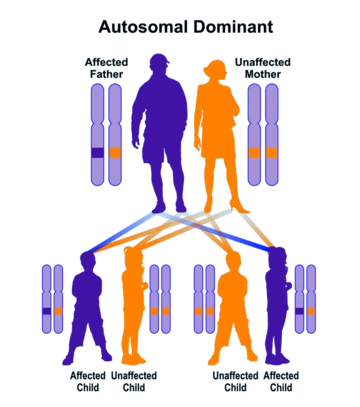
Autosomal dominant inheritance leads to a vertical pattern of transmission